

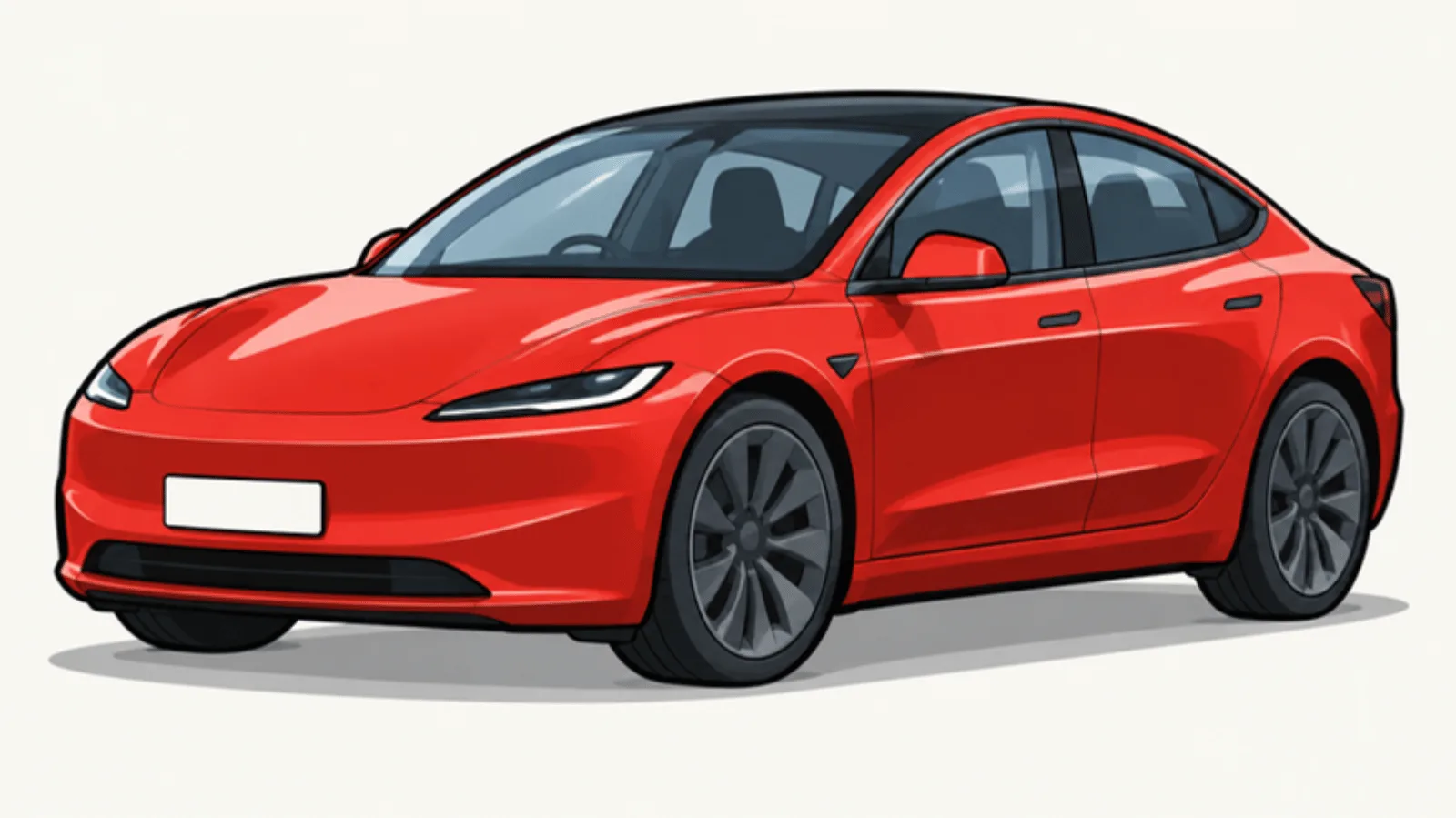
Tesla Model 3 Premium AWD (2026 on) charging guide
Premium AWD · 2026 on · 79 kWh usable battery
At a glance
- Battery
- 79kWh usable
- Home charging
- 11kW max
- Rapid charging
- Checking
- Range
- 340miles typical
Your plugs
Your charging port is on the side of the car. It has a Type 2 socket for slow and home charging. With the two big pins underneath, the whole socket is CCS, for rapid charging. Its kWh figure is how much energy the battery holds; a charger's kW figure is how fast it charges.
Which chargers can I use?
The charger's power is the most it can give. Your car takes whichever is lower: the charger's limit or the car's own limit. On home and AC posts, the car's limit is set by its onboard charger.
| Charger | Charger power | Your car gets | Can you use it? | What you need |
|---|---|---|---|---|
| 3-pin household socket | 2.3 kW | 2.3 kW | Yes | Your own “granny” cable (occasional or emergency use) |
| Lamp-post charger | 5 kW | 5 kW | Yes | Your own Type 2 cable |
| Home wallbox | 7 kW | 7 kW | Yes | Usually tethered (cable attached) |
| Public AC post | 7 kW | 7 kW | Yes | Usually untethered: bring your own Type 2 cable |
| Fast AC post | 22 kW | 11 kW Limited by your car | Yes | Untethered: bring your own Type 2 cable |
| Rapid | 50 kW | 50 kW | Yes | Tethered CCS cable at the charger |
| Rapid | 100 kW | 100 kW | Yes | Tethered CCS cable |
| Ultra-rapid | 150 kW | 150 kW | Yes | Tethered CCS cable |
| Ultra-rapid | 350 kW | 350 kW | Yes | Tethered CCS cable |
How long will it take?
Typical times for a 79 kWh battery in mild weather. Set your own start and end below.
| Charger | 20% to 80% | 10% to 100% | Your choice (20% to 80%) |
|---|---|---|---|
| 3-pin household socket 2.3 kW | about 23 h | about 35 h | about 23 h |
| Lamp-post charger 5 kW | 10 h 32 min | 15 h 58 min | 10 h 32 min |
| Home wallbox 7 kW | 7 h 31 min | 11 h 27 min | 7 h 31 min |
| Public AC post 7 kW | 7 h 31 min | 11 h 27 min | 7 h 31 min |
| Fast AC post 22 kW | 4 h 47 min | 7 h 21 min | 4 h 47 min |
| Rapid 50 kW | 23 min | 1 h 43 min | 23 min |
| Rapid 100 kW | 23 min | 1 h 5 min | 23 min |
| Ultra-rapid 150 kW | 23 min | 52 min | 23 min |
| Ultra-rapid 350 kW | 23 min | 46 min | 23 min |
Rapid chargers slow down a lot after 80%. On a journey it's usually quicker to charge to 80% and stop again later.
How much does it cost to charge?
- 0–100% at home off-peak
- £6.14
- 0–100% at home standard
- £23.09
- 10–80% on a rapid charger
- £43.69
Typical editable rates: 7p per kWh off-peak, 26.3p standard and 79p on a rapid charger, with about 10% added for charging losses at home.
How to charge, step by step
At home (wallbox)
- Step 1: Park so the cable reaches the socket on the side of the car.
- Step 2: Open the charge flap and plug in. Most cars lock the cable once charging starts.
- Step 3: Charging starts straight away, or at the time set in the car, the wallbox app or your energy tariff (for cheap overnight rates).
- Step 4: To unplug, unlock the car first. The cable stays locked until you do.
Public AC post (lamp-posts, supermarkets, car parks)
- Step 1: Check the price on the post or in its app.
- Step 2: Most posts have no cable: plug your Type 2 cable into the post first, then into the car.
- Step 3: Start the session by tapping a contactless card, scanning the QR code or using the operator's app.
- Step 4: Check the car's dashboard or app to confirm it's charging.
- Step 5: To finish, stop the session, unlock the car, then unplug both ends.
Rapid charger (motorway services, charging hubs)
- Step 1: If your car can precondition (see below), start navigation to the charger first.
- Step 2: Take the CCS cable from the charger (hold it by the handle, it's heavy) and push it firmly into the car's lower socket.
- Step 3: Tap contactless or use the app. The car and charger “handshake” for up to a minute before power flows.
- Step 4: The screen shows speed and cost. It will slow down after 80%.
- Step 5: Press stop on the screen or in the app, wait for the plug to unlock, then hang the cable back up.
- Step 6: If it won't start, unplug, re-seat the plug firmly and try again, or move to another bay. Report broken chargers in the app.
Battery preconditioning
Batteries charge fastest when they're warm, around 20–40°C. In cold weather a battery can accept far less power, so a rapid charge can take twice as long. Preconditioning means warming the battery on the way to the charger so it's ready to charge at full speed. It uses a little energy but can save a lot of time on a cold day.
On the Model 3
Manual only: start it from the car's battery/charging menu or the app about 20–30 minutes before you arrive.
Heads up
Good to know
Paying at the charger
Most new public chargers take contactless, and you don't need an app for every network. See how each network takes payment, and which app is worth having.
Next steps
Questions people ask
Related cars
Figures are typical and vary with temperature, battery health, software version and the charger. Always follow your car's handbook.